
Wednesday, July 17, 2013
OMG I'm going to Artscape!
Just got word this morning that I'm going to Artscape in Baltimore! No time to blog - frame all the things!


Saturday, June 29, 2013
New petri dishes!
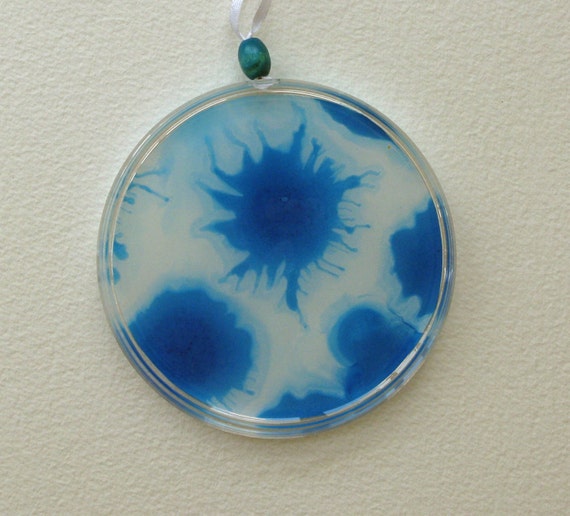
I made some new petri dish ornaments this week. I know Christmas is a long way off, but people keep searching for them, so why not? I tried something new, using pieces of a couple of the paintings I made in ink on mylar (clear plastic) or Yupo (translucent polypropylene). Results were pretty good! You can see a bunch in the shop.
For Better Science Meetings, Invite an Artist
- Regina Holliday shows artwork that she live-painted at a conference

So you’re putting together a scientific conference. You’ve chosen your topic, location and date. You’ve booked a venue and lined up sources for coffee, lunch and cocktails. You have all your podiums in a row. You’re scouring the planet for the top experts in the field, hoping that you can get enough of them in one room at one time to spark a great conversation, launch a new initiative, maybe even shift a paradigm or two. Here’s something that might help you accomplish that: invite an artist.
Why should conferences invite artists? What do they bring to the table? I asked Regina Holliday, who has been live-painting at health care conferences for three years. “I disrupt them,” says Holliday. “I give them a different worldview,” adding that her “very visual” take on the proceedings of large meetings can cut through the massive pileup of verbal information that most conferences provide.
That outsider perspective is key, says Ben Lillie of TED, noting that “inviting people who engage with culture is crucial if a field wants to be relevant.” Some conferences have already figured this out. One of the most innovative meetings in the science field, TEDMED, an offshoot of TED that focuses on the future of health and medicine, featured not only top researchers, but a songwriter, a poet, and a dancer at its 2013 conference. Students and faculty from the Rhode Island School of Design painted portraits of all the speakers, which were used in printed materials and on-site.
The AAAS (American Association for the Advancement of Science) took the theme “The Beauty and Benefits of Science” for its 2013 meeting, which featured panels such as Art as a Way of Knowing and Integrating Art and Design into STEM Education. ScienceOnline 2013, a major gathering of science communicators, featured a broad range of panels on science-related art ranging from cartooning to video to rap. But these are exceptions. Most scientific conferences follow a predictable format: presentations by researchers, panel discussions and poster sessions. Breaking the mold requires a leap of imagination.
Regina Holliday was already painting murals about her own and others’ bruising experiences with the medical system, when Kevin Kruse of ePatient Connections asked her to speak at a meeting in 2010, and suggested she live-paint her interpretations of other speakers’ messages and auction off the finished paintings for charity. She hasn’t stopped since, attending dozens of meetings and conferences, including TEDMED, and generally producing a canvas a day based on the proceedings. At many such meetings, “the people on stage get to speak, but the people in the audience don’t. But I’m in the audience painting, so people talk to me,” says Holliday. She says that her role enables her to express the content of the people in the crowd as well as those on stage.
Of course, not every artist can whip up a masterpiece on-site. What works for Holliday, who paints with acrylics, would clearly not be practical for an artist working in clay, glass or fiber. However, less portable types of art can easily be incorporated into conferences in other ways, via projections or video, for example. If the venue allows, large-scale art can be installed ahead of time or exhibits coordinated at nearby spaces which could then host lunches or cocktail receptions for conference-goers.
Biology professor and frequent conference attendee Jonathan Eisen notes, “Art added to talks can be very powerful and allow or force people to think differently about the topic.” Instead of (or in addition to) text-based slides, presenters can show artwork relevant to their topics. For example, biologist Jack Gilbert of Argonne Labs often shows this piece that I painted based on his microbiome work when he speaks at meetings, and Eisen suggests that artwork could also be shown alongside research posters.
Certainly, there are areas of science in which art is directly relevant to the research. Visual and auditory processing, for example, are fields that practically demand art and music as an integral part of presentations of the science. But artists are working on many topics that would also fit easily into conference programs. I could see Jessica Beels’ sculpted paper neurons and viruses at SfN or ASM. Rebecca Kamen’s Elemental Garden, based on the periodic table, at ACS. Laura Moriarty’s geologic strata in encaustic at AGU. And imagine Angela Mele’s gorgeous paintings of slime molds presented to a room full of mycologists. Bliss!
Which brings up another point: Inviting artists to scientific conferences is not only good for scientists, it’s good for artists. Major scientific meetings like AAAS, ASM and ACS are attended by around 10,000 people every year. The mammoth SfN annual meeting brings in nearly 30,000. Meanwhile, an artist might work for years on a gallery show that only attracts a few hundred. Online exposure can expand the audience, certainly. But scientists continue to travel and pay to attend conferences in person, even when they can stream them live on their laptops for free. Why? Because the experience of being there - the conversations, the introductions, the total immersion in their chosen field - is worth the time and effort. This is true for artists too.
Artists at scientific conferences can do far more than show and discuss their work. They can talk about the science that inspires them, or in some cases the science they have developed to carry out their work. Some examples might be Franziska Schenk’s work on iridescent paint chemistry or Charlotte Jarvis’ development of a bio-engineered bacterium for an art project. They can explore ways that artwork can be used to communicate science to new audiences or to evoke a sense of wonder.
“Scientists desperately need to interact with artists more,” says Jonathan Eisen, who attends up to 10 scientific conferences a year. “One good way to do that is to have an artist invited to the meetings.”
__________________________________
Need some more suggestions for artists to invite? Start here
This post was originally published at The Finch and Pea on June 26, 2013.
Sunday, April 28, 2013
Long Time No Blog
In case you've been wondering why I've been so bad about posting here lately, it's really because I've been very good about posting over here, at The Finch and Pea. I'm contributing two pieces a week now: an Art of Science post on Wednesdays and a Science Caturday post on Caturdays...er, Saturdays.
The best way to catch up with everything you missed is to click on the Finch and Pea Pinterest boards. All my art posts are here and my cat posts here. When you see one that looks interesting, you can click through to the original piece.
I'm going to try to be better about keeping up this blog, posting on my own artwork. But as this wise old owl knows:

The best way to catch up with everything you missed is to click on the Finch and Pea Pinterest boards. All my art posts are here and my cat posts here. When you see one that looks interesting, you can click through to the original piece.
I'm going to try to be better about keeping up this blog, posting on my own artwork. But as this wise old owl knows:

Time to get the tent out of storage - upcoming events
Spring is here and it's about time to dust off the tent and take my art on the road. I kick off next weekend with the MV Big Flea in Alexandria, VA, and I'm planning that one as a "clearance sale" so come out for great bargains. Alas, I decided not to do the SoWeBo festival and the Visionary Art Museum is not having its regular street fest this year, so I may not be in Baltimore at all this summer.
I assume I'll be adding more events, but here's what the schedule looks like now:
May 4: MV Big Flea, Alexandria VA
May 5: Riverdale Park Arts Fest, MD
June 1: Art in the Park, Westminster, MD
June 16: Old Town Arts & Crafts Fair, Alexandria VA
July 6: DC Meet Market, Logan Circle, DC
October 19-20: Art @ The Park, Annapolis, MD
Also, from May 8 to June 6, I will have a few larger paintings on display at Tryst in Adams Morgan.
I assume I'll be adding more events, but here's what the schedule looks like now:
May 4: MV Big Flea, Alexandria VA
May 5: Riverdale Park Arts Fest, MD
June 1: Art in the Park, Westminster, MD
June 16: Old Town Arts & Crafts Fair, Alexandria VA
July 6: DC Meet Market, Logan Circle, DC
October 19-20: Art @ The Park, Annapolis, MD
Also, from May 8 to June 6, I will have a few larger paintings on display at Tryst in Adams Morgan.
Monday, January 14, 2013
ScienceOnline People: Tell Me What You Want

I mentioned a few months ago that I would be attending the
wonderful ScienceOnline conference that kicks off on January 30th in
North Carolina. It’s only two weeks away,
woo-hoo!
So now would be a great time for my fellow attendees to take a look at
my work and tell me if there’s anything you would like me to bring along so you
can see it “IRL”. I will have all the
various designs of silk scarves with me, plus a few one-offs.
If there’s a particular painting or collage in my shop that
you would like to buy, please let me know in advance – I can knock off the
shipping cost and hand-deliver. (Don’t forget to use code TWEEPS for 10% off) Otherwise,
if you have a few you would just like to look at, send me a message via etsy,
email or twitter, and I will make sure to bring them.
Also, if there’s anything you would like me to paint for you
– your favorite microbe, parasite or cell, or mitosis in your team colors –
please let me know this week. I’m fairly un-busy right now, and I would love to
sell some art to offset the cost of the conference. And wouldn’t you love a
one-of-a-kind memento of this great event? Please note: there’s always a chance
that buying me drinks will reduce the price of a painting. Tell your friends.
Oh yeah, and come to the session I'm co-moderating with Cedar Riener on visual metaphors at the intersection of science, language and art, Thursday at 4.
Tuesday, January 8, 2013
I Lost a Bet

If you know much about me, you know that I am a big Pittsburgh Steelers fan. My family lived in Pittsburgh for years, and I went to high school there. Plus, it's very easy and pleasant to be a Steeler fan most of the time. They almost always make the playoffs, and they've won the Super Bowl more often than any other team. They are also fortunate to be in the same division as the Cleveland Browns, whose level of success has been somewhat - ahem - lower over the years, to the endless delight of Steeler fans.
I should just come out and say it. I found out one of my twitter buddies, Scott Huler (@Huler), was a Browns fan, and I rashly bet on the outcome of a game and lost. Oh, the humiliation! Never mind that the Steelers lacked their best players on both offense and defense that day, they should really be able to beat the Browns while wearing flipflops in a driving rainstorm. And they didn't. They lost. And so did I.
So I was forced to produce a Cleveland Browns-themed painting for Scott. I actually painted two. My kid came in while I was painting and asked incredulously, "Why are you painting in the BROWNS' colors?" Indeed, Paul Brown, whatever possessed you to pick orange, brown and white?
Never mind that. I am a woman of honor, and I keep my promises. Here they are Scott - take your pick of "Mitosis in (Cleveland) Browns" or "I <3 the Cleveland Browns". I'll cheer for Denver in the playoffs if you will. But I will not be betting on the outcome.
Subscribe to:
Posts (Atom)